The photos of the juveniles and post-juveniles were also taken during the ‘Golden day’ of October 8th, 2017, when 16.655 common buzzards migrated over the Falsterbo peninsula. These young buzzards have been classified in the same way as the adults on the previous page, i.e. based on the six colour forms or morphs of Génsböl (2006) and ‘normal’ replaced by ‘almost dark’. This page is an update of the article ‘Unga ormvråkar’ (Young common buzzards) in the magazine ‘Vår Fågelvärld’, No. 6, 2018.
All juvenile and post-juvenile common buzzards differ from the adult birds photographed through the streaked underside of the body, in particular the breast. Additionally, they lack the obvious terminal tail-band of the adult plumage. As for the adults, the presentation of the juveniles ranges from the darkest morph to the lightest morph.
Darker juvenile morphs
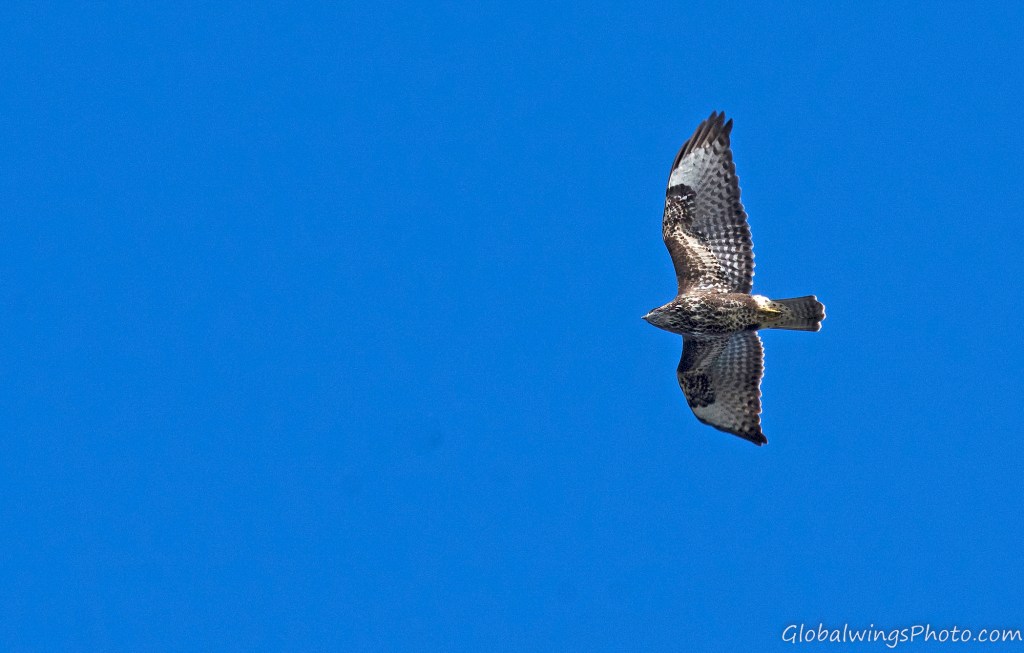
The juvenile on Photo 1 (J1) is classified as belonging to the ‘dark’ morph, since its head and body are dark with faint streaks, and breast-band. The primary and secondary coverts are dark except for the irregular pale spots across the greater secondary coverts.
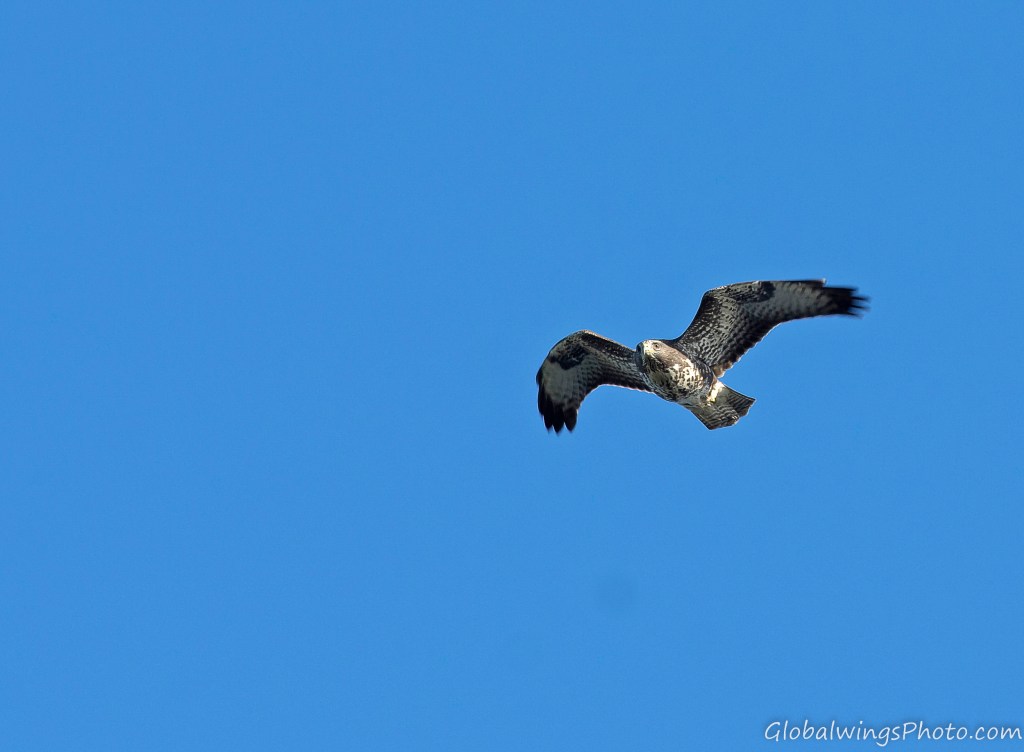
The plumage of J2 has more light elements and is therefore classified as ‘almost dark’. The throat is streaked and there is a breast-band together with a pale band across the greater secondary coverts. The median secondary coverts and primary coverts also have pale spots.

The intermediate light juvenile morph
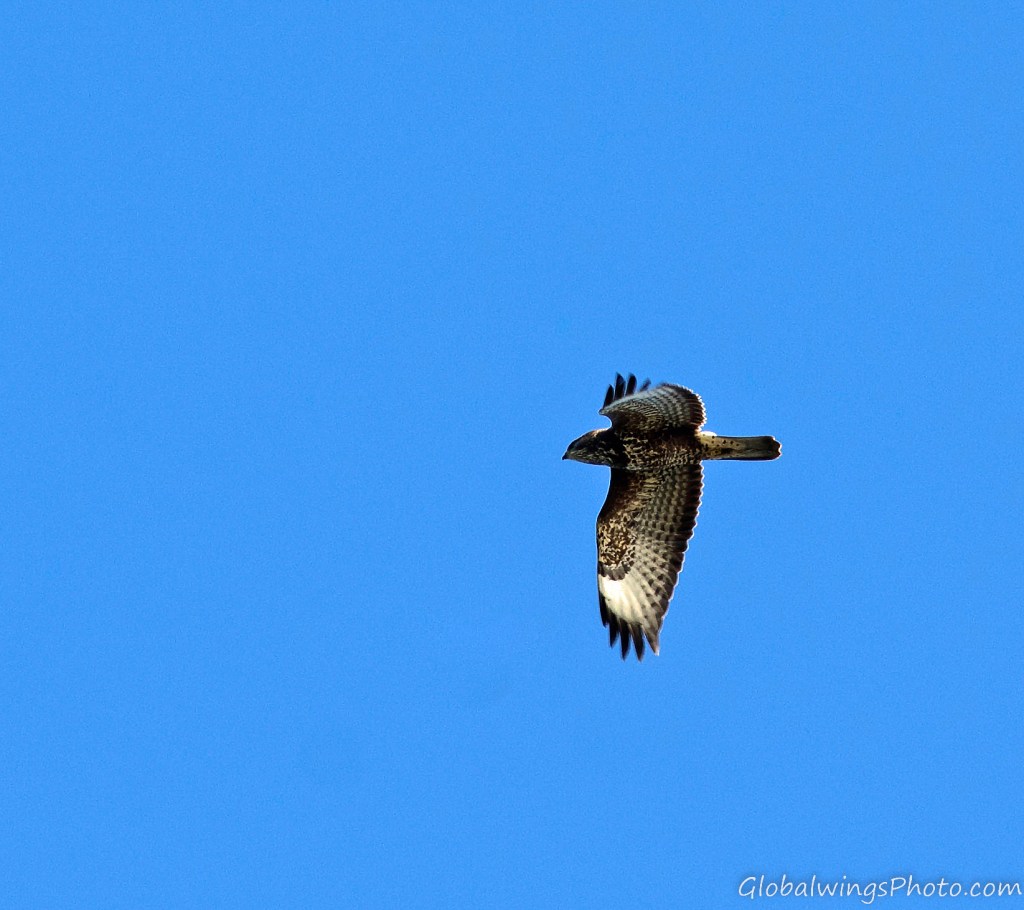
Three juveniles are neither dark nor light and found in-between these and are positioned to belong to the ‘intermediate light’ group. The body of the juvenile of J3 is heavily streaked with a breast-band, pale belly and vent, and large wing-windows. There is no pale band across the median and greater secondary coverts, which are spotted. J4 is rather similar to J3 but is somewhat lighter. The head is dark, inclusive of the throat. The breast is spotted, and the belly is pale. Furthermore, the median and greater secondary coverts establish a broad pale band with dark spots forming streaks, while the lesser such coverts are darker with pale spots. The primary coverts are dark-streaked with a black spot supremely, and obvious wing-windows. J5 is also lighter than J3 and give a more streaked appearance than spotted. The chin and the breast band are streaked. The rest of the body, and the secondary and primary coverts are lighter than J4 and streaked except for the patagium.

Lighter juvenile morphs
The lighter morphs as a group are mainly distinguished from the previous ‘intermediate light’ morph based on their clearer bands on the wing-coverts, being almost wholly pale compared to the ‘intermediate light’ morph. J6 correponds to Gensböl’s category ’almost light’, J7-J8 to the category ‘light’, while J10-J11 match the ‘very light’ category. J9 is hard to place in any of these morphs, since it is found in-between the ‘light’ and ‘very light’ morphs.
J6’s ’almost light’ morph is signified by a dark breast with an obvious band, pale chin and throat, a broad streaked pale band across the median and greater secondary coverts together with wing-widows and mainly dark coverts.
The ‘light’ morph of J7 is paler than J6 with its light body except for somewhat streaked breast and belly, and no breast band, a pale band on the secondary coverts with streaked lesser and marginal secondary coverts, paler primary coverts with a carpal arc and large wing-window. J8 is rather similar to J7 but is even paler with only a few streaks on head and flanks, making the carpal arc even more obvious.
J9 is placed in-between the ‘light’ and ‘very light’ morphs due to its pale body and very pale underwing, pale head, belly, and crissum. These light parts contrast to the heavily streaked breast without a band, dark primary coverts and trailing edge.
J10 is very similar to J9 but paler and is classified as ‘very light’ due to the lesser streaked breast and lighter primary coverts, where the dark part is limited to forming a carpal arc. J11 is the palest among the juveniles photographed and therefore a more obvious ‘very light’ bird. The underside is completely pale except for somewhat streaked head, dark small carpal arc and trailing edge.

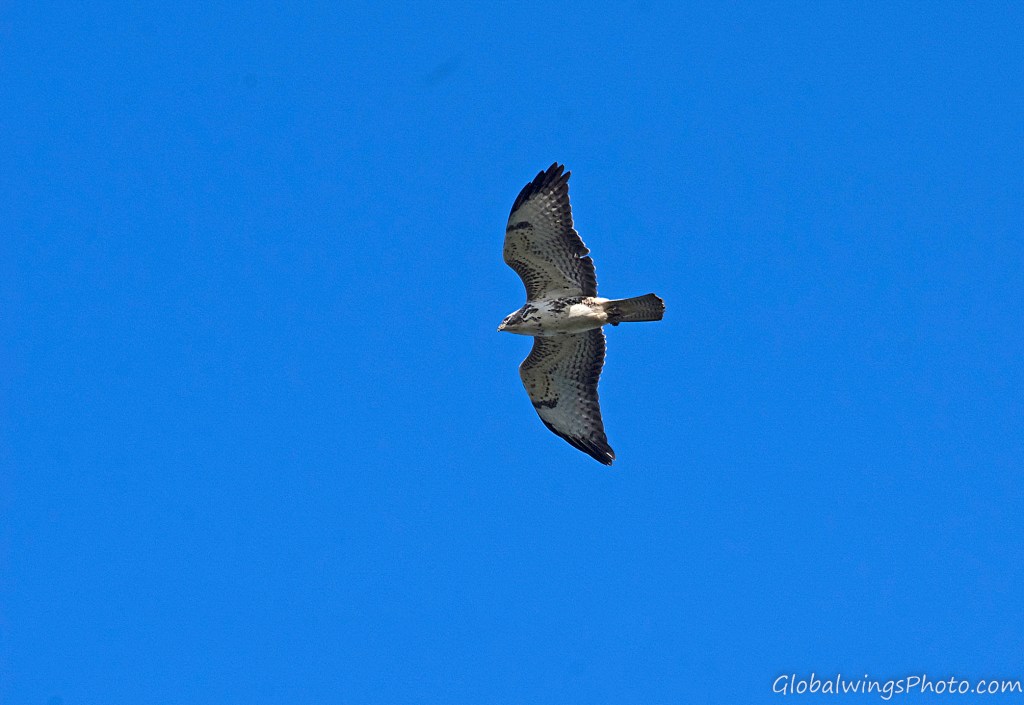


Post-juvenile common buzzards
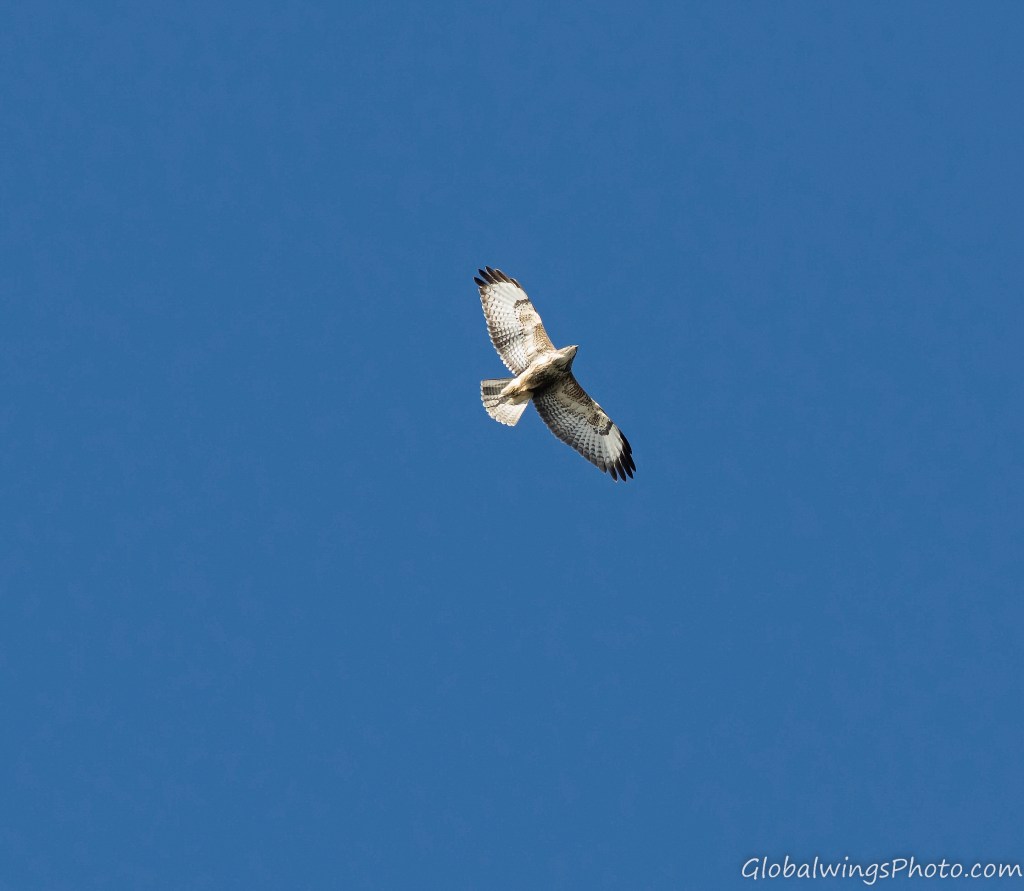
Based on Forsman (2016), I classify one buzzard photographed as a first-adult, a post-juvenile buzzard that has completed its first moult (PJ1). This buzzard retains the juvenile characteristics of a streaked chin and breast contrasting with the adult traits of a barred lower breast, belly, and median and greater secondary coverts as well as primary coverts. The narrow and irregular tail band of the juvenile is still present as well as some retained short and faded feathers in the wings.
Based on Génsböl (2006), I also classify another young buzzard as a first-adult post-juvenile bird, but which seems to differ in not having completed the first moult (PJ2). As PJ1, it exhibits the trait of a streaked part above the breast-band, and a barred part below as well as a pale band on most of the median secondary coverts plus the juvenile-like tail. However, the primary coverts are faintly barred, while some streaks remain on the secondary coverts. Juvenile remiges are also present. This makes it harder to determine the age of this bird based on only the underside, not being possible to exclude a juvenile plumage. Moreover, I abstain from trying to determine the morph of these two buzzards due to scant knowledge about how the different morphs develop from juvenile to adult.

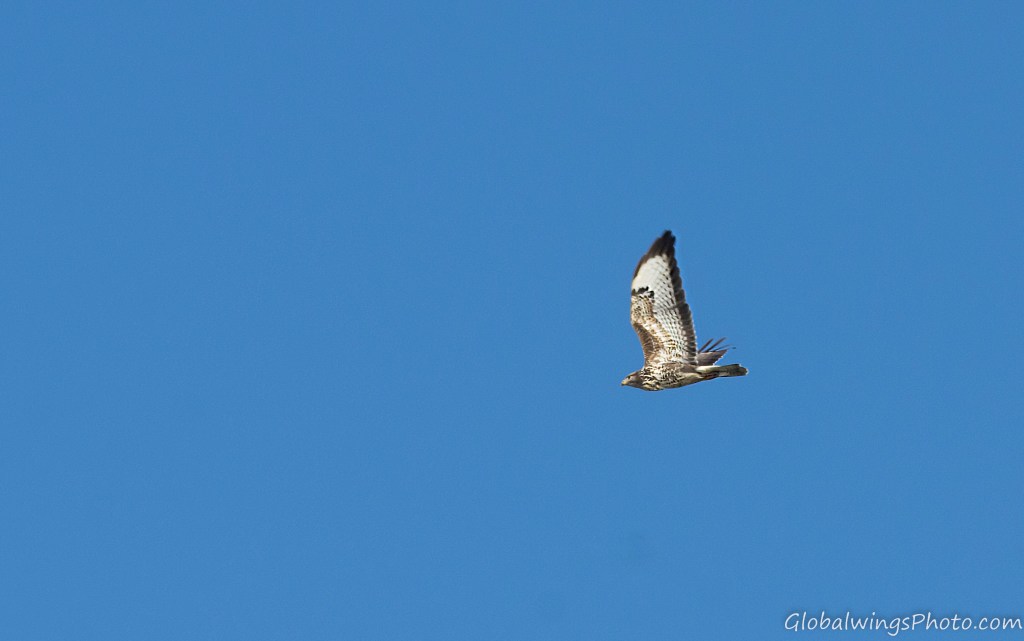
Conclusions
All Gensböl’s six morphs are represented among the juveniles photographed migrating over the Falsterbo peninsula. A major finding is that many lack the breast-band that is stressed as a distinctive trait of common buzzards in many field-guides. Another finding is that the pale band across the median secondary coverts is not typical, being either broader by also including parts of the greater coverts or missed, especially among the ’light’ and ‘very light’ morphs. A sole carpal arc is also only found among juveniles of the latter morph. A major conclusion is that the great variation of light plumages among juveniles is lost if they all put into one large and heterogeneous group and giving them once common name, for example ‘Börringevråk’, which is common in Swedish field guides.
 Globalwings Photo